
Thinking in Bars

The basic unit of rhythmic structure in a song is called a bar.
Thinking in bars allows you to better understand how structure is built up in songs. This will help you write stronger melodies, as well as improve melodies that seem to be going nowhere.
In this post, we’ll look at a few ways you can learn to think in bars, and we’ll discuss an exercise that can help you use this skill when writing your own songs.
Bars and structure in a song
You may be familiar with time signatures like 4/4 or 3/4. The first number in a time signature tells us how many beats there are in a bar.
Think of beats as the basic pulse of the song. When you’re tapping your foot to a song, you’re probably tapping along with the beats.
In 4/4 time, every 4 beats make up a bar. You can count the beats off as follows:
| 1 2 3 4 | 1 2 3 4 | ...
In popular music, it’s common for a section to contain 8 bars. A section could be a verse, for example.
Sections can be subdivided into phrases. Think of a phrase as a complete musical thought. Phrases are often 2 or 4 bars long.
One way to identify phrases in a song is to listen for breathing space in the melody. Breathing space at the end of a phrase gives the impression of having stated one complete idea.
Let’s look at how the structure of a song is built up from beats:
- Beats are grouped into a bar (often in groups of 4 or 3 beats).
- Bars are grouped into a phrase (often 2 or 4 bars).
- Phrases are grouped into a section (like a verse, chorus, or bridge).
- Sections are grouped into a song.
Listening for song structure
The ability to recognize structure in songs is a valuable skill for songwriters. It helps you understand how songs work, and also helps you build and revise your own songs.
Even non-musicians can often recognize major sections in a song. But counting bars is the starting point for hearing more fine-grained structure.
Counting the beats in a bar
Practice counting along to songs as you listen to them. If you’re new to this, a good first guess is that a song has 4 beats to a bar. So try counting 1-2-3-4 over and over as you listen.
If the count doesn’t line up with the song, you can try 3 beats instead. If that doesn’t work, you may have chosen a song with a more unusual structure. For beginners, it’s best to leave more experimental songs aside until you internalize the basics.
Once you find the right count, you’ll be counting off the beats in a bar:
| 1 2 3 4 | 1 2 3 4 | 1 2 3 4 | 1 2 3 4 |
Counting bars
Once you have the basic count down for each bar, it’s time to search for larger structure. Pick either the verse or chorus as a start.
Wait until the section begins, and then start counting. With each bar, increment the first beat number by one. For example:
  1         2         3         4
| 1 2 3 4 | 2 2 3 4 | 3 2 3 4 | 4 2 3 4 |
You’re now counting bars.
Keep counting up until the section comes to an end. You’ll often find that a section is 8 or 16 bars long.
If the section is 16 bars long, pay attention to whether it is effectively the same 8-bar part played twice in a row.
Finding phrases
Now that you know the boundaries of the section, it’s time to look for the phrases within that section.
The first thing to look for are breathing points in the melody. A good initial guess is that these will occur every 2 or 4 bars.
Not all songs follow this simple structure however. As you count the bars in the section, just pay attention to natural stopping points in the melody, or moments where a complete thought seems to end.
If you’ve never thought about phrases in a song before, this can be a powerful exercise. It will reveal aspects of the melody you might not have noticed before.
Once you think you’ve identified the phrases, pay attention to how they are related to each other.
- Are the phrases exact repetitions?
- Do they have subtle differences?
- Are some longer and some shorter?
- Do they seem to work in pairs?
- Are they imbalanced? For example, does it sound like 2 phrases are followed by 1 phrase?
Listening to melodies in this way can be a source of many ideas for your own songs. Look for all the subtle (and not-so-subtle) ways great songwriters create and maintain interest through the structure of their melodies.
The looping bars exercise
If you want to learn a new skill, it’s useful to find ways to focus on just the aspects you’re trying to improve.
The looping bars exercise is one way to focus your attention on different levels of song structure.
The goal of the exercise is to consciously write phrases of different lengths.
Start by picking a phrase length to focus on. I recommend beginning with 2 bars.
In your DAW, highlight 2 bars and turn on looping mode. I recommend turning on the metronome, which marks off beats with ticks and bars with accented ticks.
Now pick a root note for your melody. Either program in or record that note at the very beginning of your 2 bar loop. Use whatever instrument or sound is most inspiring for you.
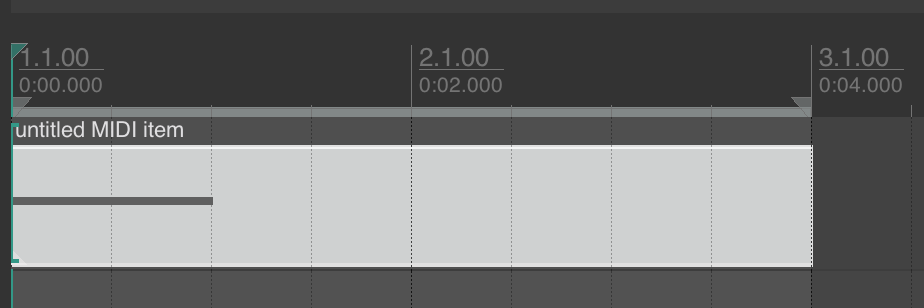
When you play the part back on loop, you’ll hear the root note mark off the beginning of the 2 bars as they repeat.
Your goal now is to sing or play a melodic phrase that lasts 2 bars. I recommend singing for 2 bars, then leaving 2 bars of silence, then singing again.
The repeating root note will help ground your melody, and will also help you hear the structure more clearly. You can always turn it off if you find it distracting or unnecessary.
Once you have 2 bars down, try 4 bars, 8 bars, and 1 bar. Experiment with different levels of repetition in your melodies. Play with phrases that sound balanced and phrases that sound imbalanced.
Record your favorite melodies. Keep in mind that a 1 or 2 bar phrase can be developed into an entire song.
Next steps
I recommend you practice counting bars as you listen to a wide variety of songs. Eventually, this will become second nature.
Take notes whenever you notice something interesting about a song’s structure. You can build your own exercises around any new ideas you encounter.
Explore your own past songs as well. See if you tend to use the same structures over and over. This will help you identify habits to break, as well as new areas for experimentation.
And once you have learned to think in bars, you can consiously use them to shape how notes are emphasized in your melodies.