



Harmonic Functions for Songwriters
Why do some chord progressions seem to tell a clear story and others just meander?
Many songwriters look for a framework that explains why certain chord combinations work and others don’t.
In reality, there are many such frameworks, but none are perfect (particularly when it comes to popular music).
But it can still be helpful to learn some of the fundamentals from traditional music theory, even if they were tailor-made for European classical music.
Let’s look at one such concept that can shed light on how chords relate to each other: the concept of harmonic functions.
The Chords in a Major Scale
Harmonic functions are always relative to a scale. In this post, we’re going to focus on major scales.
A major scale has seven notes, and each of these can be used to create a 3-note chord called a triad. Triads made up of only notes in the major scale are called diatonic. A diatonic triad is either a major chord, a minor chord, or a diminished chord.
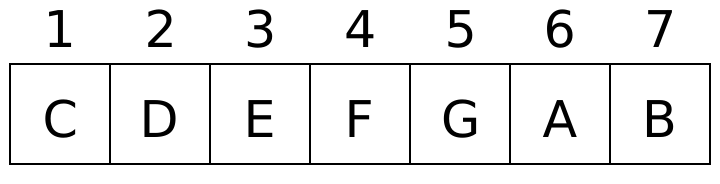
Here are the notes in C major, along with the position or scale degree of each note:
And here are the triads built on each of these notes in the key of C major, with the scale degree of each root note:

The order of major, minor, and diminished (°) chords is the same for any major key. And it can be written using Roman numeral notation. Here are the Roman numeral symbols for each of the 7 chords in a major key:

That’s enough about major keys for our purposes here. You can always dig further into music theory for songwriters here.
The 3 Harmonic Functions
Each of the seven chords in a major key can be thought of as playing one of three harmonic functions: tonic, dominant, or subdominant.
Think of a harmonic function as the tensions and tendencies of a chord in a key.
A tonic chord establishes and maintains a sense of home in the key. It’s often where we begin and where we end, both at smaller and larger levels of a song.
The I chord is the core tonic chord in a major key.
A dominant chord pulls us toward the tonic, creating tension as we wait and a sense of resolution when we arrive.
The V chord is the core dominant chord in a major key.
A subdominant chord moves away from the tonic, and only pulls us slightly back toward the tonic. This gives the subdominant the potential for acting as a temporary second home. The subdominant can also move us toward the dominant.
The IV chord is the core subdominant chord in a major key.
As I say above, each of the seven chords in a major key can be slotted into one of these functions. Here’s the complete list:
      Tonic: I, [iii, vi]
Subdominant: IV, ii
   Dominant: V, vii°
The reason iii and vi are in brackets is because there’s a sense in which I is the “true” tonic and iii and vi can be used to shadow and prolong it.
But we’re getting ahead of ourselves. Let’s start by examining I, IV, and V, the “core” chords of a major key.
The Core Tonic, Dominant, and Subdominant Chords
We can think of I, IV, and V as our core chords. All the notes in the major scale show up across these chords, which means we can use just these three chords to accompany any major scale melody.
The blues is mostly built around them, and many folk songs stick to them as well.
The I chord is our home base, the core tonic chord in major. We can start and end sections or a whole song on this chord. And we often treat it as our destination at both levels.
In the key of C major, the I chord is the C major chord.
The V chord is our core dominant chord. It pulls us toward the I chord, particularly if we play it as V7.
In the key of C major, the V chord is the G major chord.
The IV chord can be used to move us away from the I. It has a slight pull back, but we can also dwell on it, or use it to lead to a dominant chord.
In the key of C major, the IV chord is the F major chord.
Cadences, or ways of arriving home
One of the clearest places to observe these functions is in cadences.
Think of a cadence as a way of either returning home or indicating you’re returning home.
For our purposes, we are interested in 3 kinds of cadences. These are the full, half, and plagal cadences, but as a songwriter you really don’t need to know the names.
It’s the sound that matters.
Let’s start with the full cadence. First we establish our home on the I (tonic). Then we move away to the IV (subdominant). Next, we introduce the V (dominant) and a feeling of tension that pulls us back toward the I.
Finally, we resolve by returning home.
Here is one way we could write it:
    | I | I | IV | V | I |
Ex: | C | C | F  | G | C |
The most important thing to notice is how it sounds like we’re arriving when we play the final I at the end.
Now notice what happens when we play the same chord progression, but without that final return. The audio examples here will just stop on the V:
    | I | I | IV | V |
Ex: | C | C | F  | G |
This is called a half-cadence. It creates that tension to resolve, but leaves us hanging. This can be used to gesture at resolving or to create a desire to resolve in order to build and maintain tension over a section (or sections) of a song.
So the dominant V has a strong pull home. But earlier we also noted that the subdominant IV has a mild pull home. We can hear this in action in the subtler Plagal cadence (IV-I). This is also sometimes called the Amen cadence because of its use in church services when singing “Amen”.
Let’s listen to a Plagal cadence in action:
    | I | I | IV | IV | I |
Ex: | C | C | F  | I  | C |
Notice that this does not create the same degree of finality as the move from V to I. But it still creates some degree of finality.
Harmonic Functions of the Color Chords
As discussed above, we can accompany any major scale melody with just the I, IV, and V chords. But we don’t have to stop there.
The next step is to include what you might call the “color chords” of the major key. These are the three diatonic minor chords: ii, iii, and vi.
They can add depth, variety, and feeling to your progressions.
In the key of C major, these chords are:
ii, iii, vi
Dm, Em,  Am
I have elsewhere called the vi chord the shadowy twin of the tonic. The vi is actually the tonic chord of what’s called the “relative minor” key, which is the minor key built on the notes of the major scale (but starting and ending on the 6th note in major).
This fact helps explain why the vi can add ambiguity to a major key song, suggesting the possibility we might be slipping into minor. It plays a tonic function, but more as a way of deepening, prolonging, and even challenging the I.
This interesting interplay is the basis for a kind of cadence built on thwarting our expectations, the deceptive cadence. A deceptive cadence sets up what seems like a return home to the I, only to land somewhere else altogether. The vi is a favorite choice here:
    | I | I | IV | V | vi |
Ex: | C | C | F  | G | Am |
Notice how colorful that vi sounds. And see if you notice your own anticipation of a return home right before it plays.
The ii chord is our color subdominant chord. It can move us away from the I with a kind of walking motion, can substitute for the IV, and commonly leads to the V.
The ii-V-I progression is a cornerstone of jazz but can also show up in pop and rock music.
    | I | ii | V | I |
Ex: | C | Dm | G | C |
Finally, the iii chord is another color chord that can play a tonic function. The iii doesn’t create the same level of harmonic ambiguity as the vi, but can be used to add depth and color.
One way to think about it is as prolonging the I while maintaining or increasing interest.
    | I | I | iii | iii |
Ex: | C | C | Em  | Em  |
As with the vi, the iii can be substituted for the I because it shares the same function. This means that anywhere you see a I or vi in a chord progression, you can in theory play a iii instead.
Of course, in a real song you’ll have to use your ears to determine if this is a good idea!
The tricky vii°
This brings us to our last diatonic chord (i.e. our last triad in the major key). This is the tricky vii°, a diminished chord.
The vii° chord can play a dominant function, potentially substituting for the V. However, it can be difficult to use because of its dissonance and instability.
It more commonly shows up as a minor 7 flat 5 chord. That’s just a diminished chord with a minor 7th added. But in pop and rock styles, you can easily go a whole career without using this chord.
Substituting Chords by Harmonic Function
As mentioned above, you can in theory substitute a chord for any chord that shares its harmonic function. Let’s look at the list of chords we’ve considered so far:
      Tonic:  I <-> vi, iii
Subdominant: IV <-> ii
   Dominant:  V <-> vii°, vii(m7b5)
Let’s see how substitution works by returning to an earlier chord progression based on all our core chords:
    | I | I | IV | V | I |
Ex: | C | C | F  | G | C |
We’re going to find places to substitute in all of our color chords (ii, iii, vi).
Here’s the chord progression notated by harmonic function: tonic (T), dominant (D), and subdominant (S):
| I | I | IV | V | I |
| T | T | S  | D | T |
Since iii and vi fall under the tonic function, we’ll use them to replace the first two instances of I.
Since ii falls under the subdominant function, we’ll use it to replace the IV.
Here’s the result:
    | vi | iii | ii | V | I |
Ex: | Am | Em  | Dm | G | C |
What’s interesting about this is that we found a new chord progression that “sounds right” without even listening to it first.
Of course, whether it’s a good choice for your song will depend on a lot of factors, most importantly the melody! But if you find that your chord progression isn’t interesting enough, or doesn’t support the melody well, this is one technique you could try.
Or you could just use it as a way to generate new chord progression ideas.
If you’d like to start trying these ideas in keys beyond C major, you can use the following table to look up the chords in any key:

You can also find this table in my Chord Progressions Cheat Sheet↗(opens in a new tab).
What next?
Understanding harmonic functions can help you think about your options when writing chord progressions. And they can help you revise and potentially improve your progressions through substitutions.
There’s a lot more to say about them than we’ve covered here. We could get into minor keys, secondary dominants, and a range of other topics. But this should provide a good foundation to build on.
Keep in mind that harmonic functions provide one framework for thinking about the relationships between chords, but it’s not the only one. And it wasn’t a framework designed with popular music in mind, so it can only get you so far as a songwriter.
My recommendation is to experiment with these ideas in your own songwriting. Keep what works, but don’t be afraid to drop the framework and try something else.
Music theory can be helpful but it’s not a recipe for writing good songs. Trust your ears, and keep experimenting.