
Frameworks for Songwriting

As a songwriter, you have a lot of decisions to make.
There are endless combinations of notes and chords. And somehow, you need to narrow them down into a single song.
There are a number of ways you might be doing this:
- Maybe you start by playing some chord sequences that you always play.
- Maybe you play some notes in a particular scale (whether you’re aware of it or not).
- Maybe you play major and minor chords at random.
Of course, pure randomness isn’t a great solution. Most of those combinations of chords and notes sound pretty bad.
But how do you narrow your options so that you’re more likely to create good music?
One approach is to think in terms of frameworks.
In this post, I’ll explain what frameworks are, how they can help you, and how you can intentionally create your own.
Thinking in frameworks
A framework is a structure that supports the creation of something, whether that’s a building, a legal contract, or a song.
When I talk about a songwriting framework, I mean a set of perspectives, guardrails, and ideas that narrow your options and guide you in creating a new song.
Like the internal framework of a building, a songwriting framework is often invisible to most people once the song is finished. But it is a critical part of the process.
Songwriting frameworks come in many forms. An obvious example, and a good place to start, is genre.
Genre as a framework
Most songwriters have an idea of their target genre when they write, and this vastly reduces the number of musical options available to them.
For example, if you’re trying to write a punk song, you might be playing mostly power chords and major chords. If you’re mostly avoiding minor chords, it’s unlikely you’re even thinking about 7th, 6th, or minor 7th flat 5th chords.

A genre is defined by a set of conventions. Conventions include things like
- common chord progressions,
- melody and singing styles,
- tempos and rhythmic structures,
- lyrical themes,
- instruments and ways of arranging songs,
- and so on…
Writing a great song in a genre involves both satisfying and thwarting the expectations of your audience. And conventions help you do this.
Different listeners will have different levels of tolerance (or desire) for deviation from the norm.
On one extreme, there are listeners who are annoyed by anything that breaks from well-worn conventions. On the other extreme, there are listeners who obsessively seek out “new sounds” and want to be constantly challenged.
Wherever you end up on this spectrum as a songwriter, it’s likely that you’ll use the framework of genre to help guide your songwriting decisions.
For example, it’s common for songwriters to try to push the boundaries of a genre. The most common way to do this is probably to incorporate elements from another genre. This is a good example of combining frameworks, which is common in popular music.
Only a zealot could believe that music must be in a particular genre to be good. A genre, like any framework, provides one way among many to write music. You are always free to try others (and you probably should).
Music theory as a framework
Many songwriters wonder if they need to understand music theory to write great songs.
This question assumes that music theory provides some kind of deep insight into songwriting. Maybe like how physics can provide deep insights into the universe.
But I think it’s much better to look at music theory as just one more framework. Even better, think of it as a collection of many frameworks.
We actually know you don’t need music theory to write great popular music. That’s because many great songwriters didn’t know much about theory, and got along without it.
Furthermore, European and American music theory (what people normally mean by “music theory” in English writing) was developed as a description of European art music in the “Common Practice Period” (1650-1900).
It has since been further developed to incorporate many ideas from jazz. But it often struggles to describe pop, rock, and hip hop, among other popular styles.
Does that mean it’s useless for songwriters? Not at all. It just means you shouldn’t treat music theory as “rules for writing good music”.
Music theory is at its best when it helps you better understand your options. That allows you to narrow your choices to things that are more likely to “sound right” (to a certain audience). And theory can also help you understand and thwart expectations.
But you should always feel free to throw music theory away and use other frameworks in its place.
Using music theory as a source for frameworks
So how can music theory be used as a source for frameworks in your own songwriting?
I discuss a number of examples on this site. A good place to start is the idea of musical keys, like the Key of C Major.
Using keys
If you choose to write a song in a particular key, then you immediately narrow your options. For your chord progressions, you get to start from a small group of common chords in that key. For your melodies, you can start from a single scale, which is just seven notes.
These chords and these notes are very likely to “sound right” together. They give you a starting point to quickly build on.
You can print out↗(opens in a new tab) or copy something like this table of major keys. Use it by picking a row and writing a song with just those 6 chords.

Limiting yourself to a group of chords and a scale is an effective framework on its own. But you can go further by drawing on ideas about how chords work together.
Using harmonic functions to make chord choices
Chords in a key can be described as falling into groups called harmonic functions. Depending on its harmonic function, a chord will have different tendencies relative to the other chords.
For example, the three types of function (tonic, subdominant, and dominant) tend to move to each other in this way:
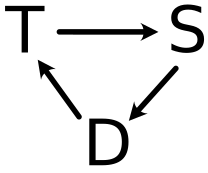
The idea of harmonic functions comes from European art music and is sometimes an awkward fit for popular music. But that doesn’t mean you can’t use it to come up with chord progressions and transitions.
Using “core” and “color” chords to write a progression
Perhaps a more intuitive way to break up chords is into what I call “core” and “color” chords. Core chords are used to establish a key and act as the backbone of the song. And color chords are used to add depth and feeling.
Again, this is not a “true” description of how chords work. It’s better to think of it as a way to constrain your choices and make progress.
Using chords from different keys
Another idea I’ve explored on this site is what I call the “super key”. This is a method for moving beyond just major and minor keys by mixing them.
Mixing keys is common in popular music. And the “super key” perspective gives you a practical way to try it out.
All of these are examples of perspectives and techniques that can help you write a song. Just don’t treat them as “the rules”.
Analogy as a framework
Some musicians love music theory. But others find it dry and uninspiring, more like math than art.
Another way to think about your options is in terms of analogies and metaphors. This can help you remember and use patterns while (hopefully) stimulating your imagination at the same time.
You might already use analogies in thinking about your choices. For example, you might think of major chords as bright and minor chords as dark.
Like any framework, this is both useful and (by definition) limiting. It can help you choose chords that can capture the feeling you’re going for. But it can also stop you from using these same chords in new ways.
This is why I recommend that you try out new frameworks on a regular basis.
As a different example, I’ve developed a set of images to help you visualize the relationships between chords in both major keys and minor keys.
For instance, I talk about the V chord as the Magnet Chord, pulling us back home to the I chord.

This captures one of the tendencies of that chord and can help you imagine different ways to use it in a song.
These images aren’t meant to capture the “true relationships” between chords. Instead, they help you internalize and play with some concepts from music theory while hopefully inspiring more imaginative connections.
I have a series introducing these kinds of analogies one chord at a time, in case you’d like to explore further.
It’s useful to learn analogies that other songwriters use. But it’s also a good idea to come up with your own!
Songwriting exercises as mini-frameworks
The frameworks we’ve looked at so far could in theory apply across many songs. But it’s also useful to think in terms of mini-frameworks.
A mini-framework sets very specific goals and limitations for a songwriting session. It can help you explore new techniques, internalize patterns, and break out of old habits.
And one great thing about a mini-framework is that it takes your mind off of “writing a great song”.
Most of the time, trying to write a great song will lead to frustration (and maybe even despair!). The good news is that you don’t need to worry about this when writing music. And you’re probably better off that way.
Using songwriting exercises
On this site, I call these mini-frameworks songwriting exercises.
A songwriting exercise is different from, say, a piano exercise for practicing scales. That kind of piano exercise is meant to drill basic techniques which you will use later. It’s not very exciting on its own.
On the other hand, when you try out a songwriting exercise, you’re actually writing music. You’re using the ideas and techniques here and now for a creative end.
A good songwriting exercise has a clear goal and a clear constraint or list of constraints. There are countless possible exercises of this kind. If you wanted, you could use exercises like this every time you write.
So what are some examples of songwriting exercises? Let’s consider a number of them:
- Use all major chords to write a verse and all minor chords to write a chorus (or vice versa). For example, my Light and Shadow Exercise.
- Come up with a phrase that you enjoy saying over and over. Pay attention to the words you emphasize and the ups and downs of your speech. Then write a melody that imitates these qualities. I describe a version of this in a post on writing choruses.
- Center your attention on a single note that you hum or sing continuously. Then gradually explore close notes as you find little motifs to build into a melody. I call this the Musical Centering Exercise.
- Pick 3 chords from a key and 1 chord from outside that key. Write a number of different progressions with these and pick your favorite(s). A version of this is described in my exercise for borrowing chords.
- Layer as many parts as you can in your DAW. Then gradually sculpt the song by removing parts, as described in my Composition by Subtraction post (inspired by Brian Eno).
I recommend keeping a list of songwriting exercises. This should include ideas you come across as well as your own ideas. Over time, you’ll get better at inventing your own exercises and modifying other people’s to better fit your approach.
Keep in mind that there’s no one right way. You can get very detailed if you want. But you can also list very simple ideas, like “start a song with a bass line”. The important thing is that you actually use the exercises!
Exercises like this will help you to just start writing, explore new ideas and techniques, and stop relying completely on your habits. I talk in more detail about what makes for an effective exercise in my post on how to practice writing songs.
Wrapping Up
Songwriting frameworks big and small help you become a more efficient songwriter, spending more time on creating songs that work and improving your songwriting skills in the process.
Thinking in terms of frameworks can also help free you from some of the dogmas of songwriting. What are some of these dogmas?
- That there is supposedly a right way to write music.
- That music theory describes that one true way.
- That there is a set of songwriting secrets that will magically produce great songs (or hits).
- That only geniuses are able to write good music.
If you understand that there are many frameworks available for writing songs, and many different traditions of songwriting, then you can begin to poke holes in these kinds of dogmas.
And more importantly, you can just ignore the dogmas and start writing music!